

Experimental Features
The Experimental section of the web app provides tools for quick, one-off tasks — useful for testing new features.
Single Epitope Prediction
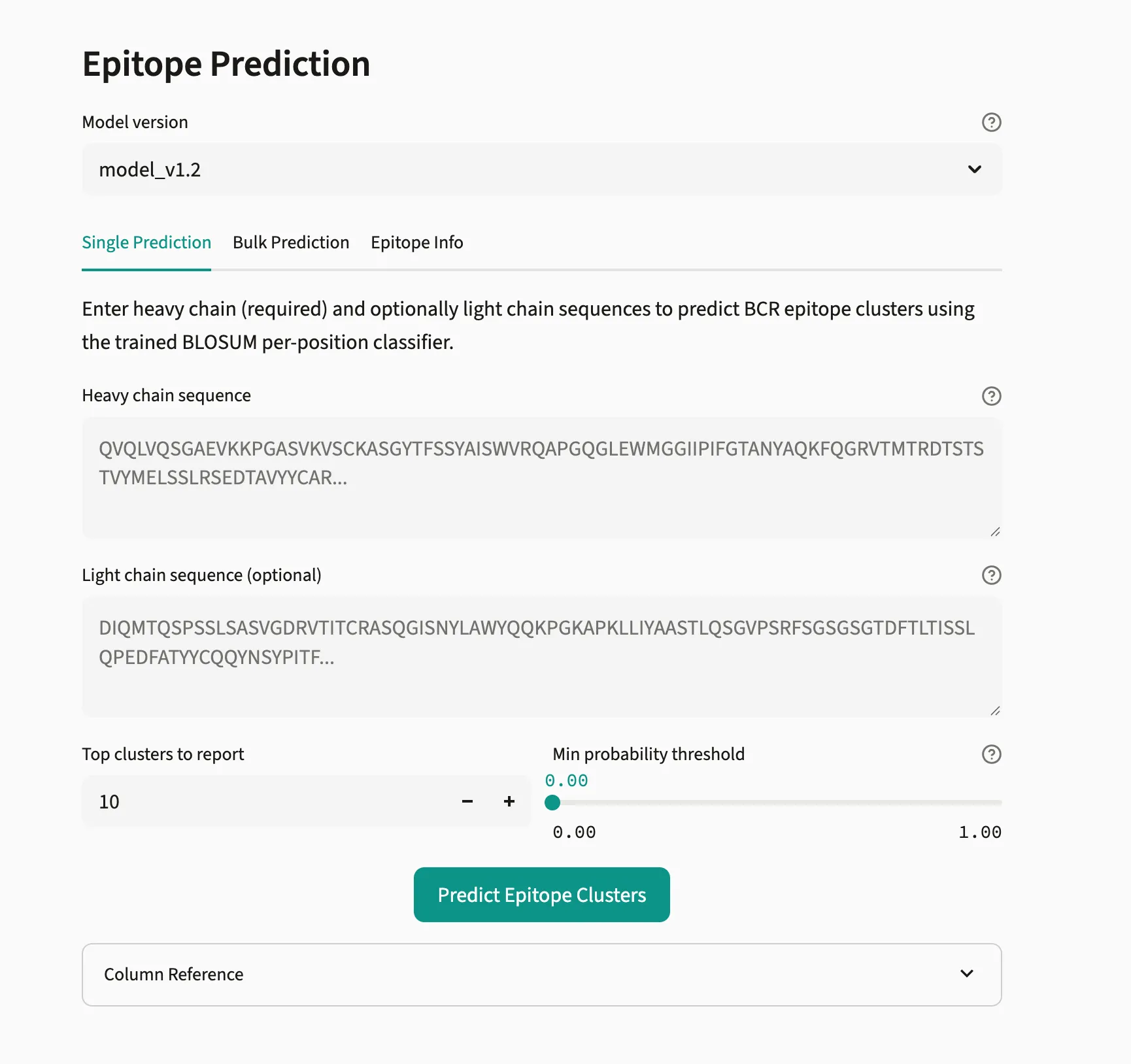
Section titled “Single Epitope Prediction”Predicts BCR epitope clusters for a single antibody using a trained classifier.
- Select a Model version from the dropdown (current:
model_v1.2) - Enter the Heavy chain sequence (required) — full amino acid sequence
- Optionally enter a Light chain sequence to improve prediction accuracy
- Set Top clusters to report (default: 10)
- Set Min probability threshold (recommended: 0.5)
- Click Predict Epitope Clusters
Result columns
Section titled “Result columns”| Column | Description |
|---|---|
rank | Rank for this query (1 = highest probability) |
mean_prob | Mean classifier probability across all reference antibodies in this cluster |
msa_cluster_id | Fine-grained epitope cluster ID (MSA-based) |
epitope_cluster | Broader epitope cluster grouping |
ag_cluster_id | Antigen cluster ID |
antigen | Antigen name associated with the predicted cluster |
n_ref_abs | Number of reference antibodies in this cluster |
rep_ids | Top-3 representative reference antibody IDs |
Single Sequence Search
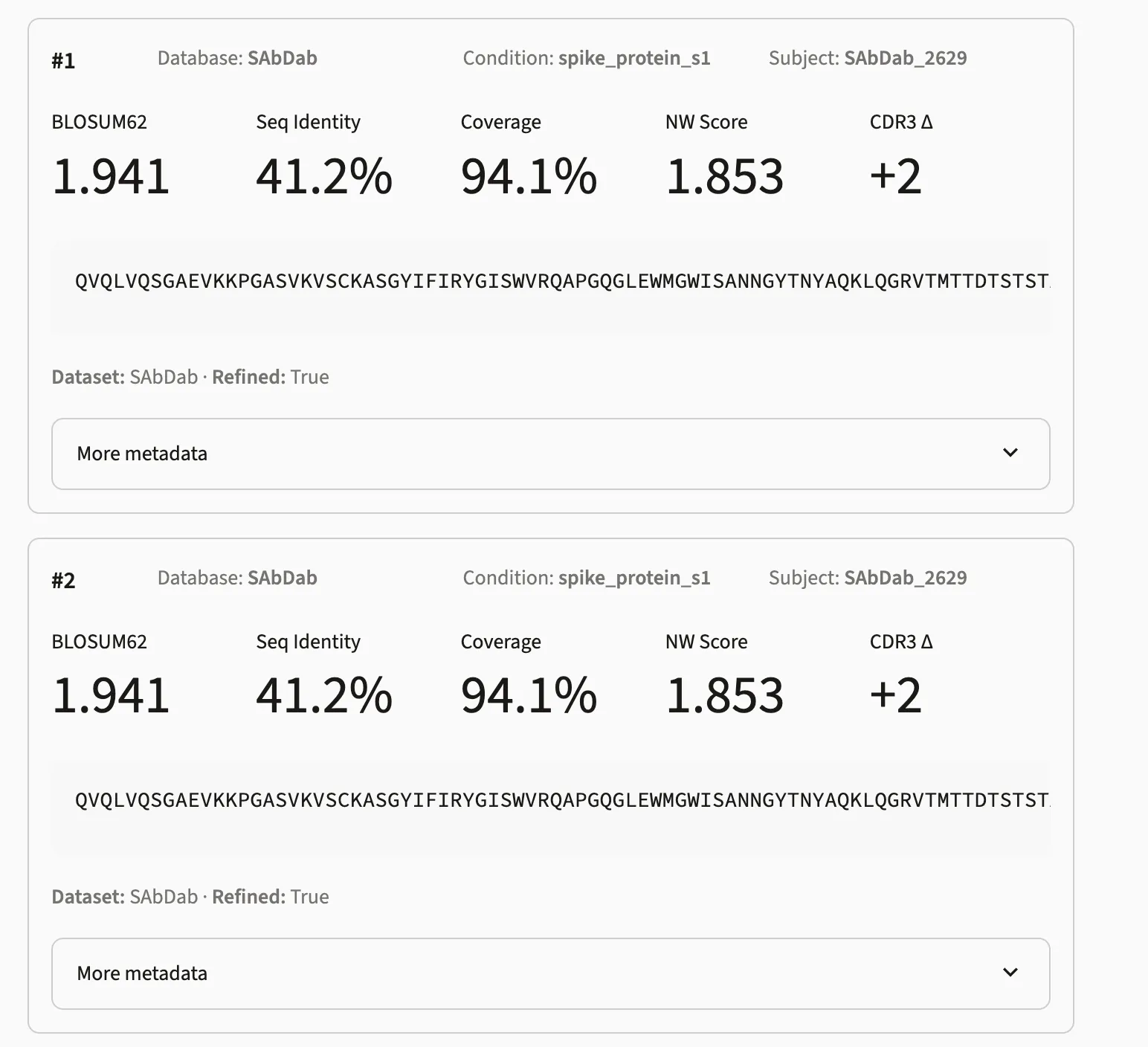
Section titled “Single Sequence Search”Search a single amino acid sequence against one or more reference databases using nearest-neighbor retrieval. Chain type and species are auto-detected from the input sequence.
- Enter an amino acid Query sequence — chain type and species are detected automatically
- Select one or more Databases to search (default: SAbDab). Once the chain type is known, the list is filtered to the matching receptor class — BCR databases for
IGH/IGK/IGLand TCR databases forTRA/TRB/TRD/TRG. All databases stay available until a chain type is determined. - Set Nearest neighbors to retrieve — candidates fetched from the indexes (default: 1000)
- Set Results to keep — top hits returned after scoring (default: 100)
- Choose Search mode: Full paratope (default) or CDR3 only
- Click Search
Results can be downloaded as CSV.
Result columns
Section titled “Result columns”| Column | Description |
|---|---|
database | Source database for this match |
aligned_sequence | Pseudo-sequence alignment of the matched target |
distance | Raw levenshtein distance — lower is more similar |
sequence_identity | Fraction of matching residues at non-gap positions (0–1) |
coverage | Fraction of positions where both sequences have a residue (0–1) |
blosum62_score | Mean per-position BLOSUM62 score — higher is more similar |
nw_score | Needleman–Wunsch score normalised by the longer sequence — higher is more similar |
cdr3_length_diff | CDR3 length difference (query − target; 0 = equal length) |
deamidation | Count of deamidation motifs (NG, NS) in the padded CDR regions |
isomerization | Count of isomerization motifs (DG, DS) in the padded CDR regions |
oxidation | Count of oxidation-prone residues (M, W) in the padded CDR regions |
refined | Whether CDR3 gap positions were repositioned via BLOSUM62 sliding-window refinement |
glycosylation | Potential N-linked glycosylation sequons (N-X-S/T, X ≠ Pro) scanned across the full target sequence — count and 1-based positions |
dataset_name | Source dataset the target sequence belongs to |
condition | Condition label associated with the target sequence |
subject_idx | Subject identifier within the source dataset |
| extra columns | Database-specific metadata (e.g. antigen.epitope, v.alpha) — fields listed under Database Info |
AF3 Config Builder
Section titled “AF3 Config Builder”Builds an AlphaFold3 job config for an antibody–antigen complex, so you do not have to assemble the JSON by hand.
Supply the antigen as a UniProt accession — the sequence is fetched for you — together with the antibody heavy and light chain sequences. The tool assembles the corresponding AlphaFold3 input config, which you can then copy out and run wherever you execute AlphaFold3.
When to use vs. full pipelines
Section titled “When to use vs. full pipelines”| Scenario | Use |
|---|---|
| Testing one sequence | Experimental tools |
| Analyzing a full cohort (100+ sequences) | Bulk pipeline jobs |
| Need results saved on cloud | Bulk pipeline jobs |
| Quick sanity check before a batch run | Experimental tools |
v1.41.2